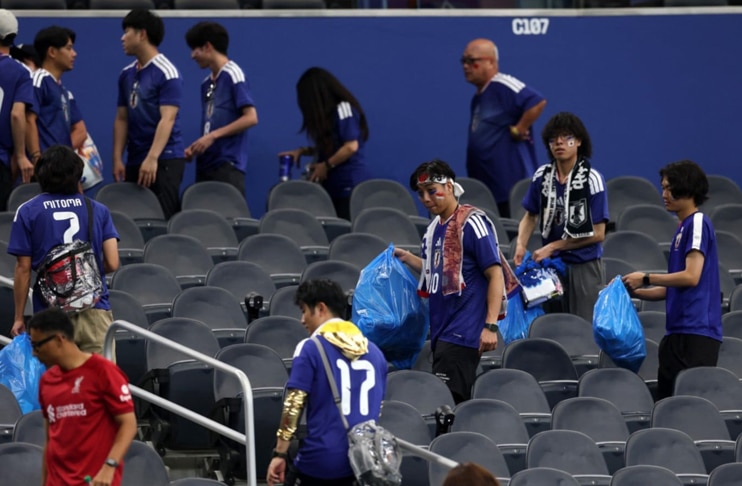
Japan fans left the stands spotless after their FIFA World Cup 2026 opener against the Netherlands at Dallas Stadium in Texas on Sunday, saying it was “Japanese culture” to tidy up after themselves.
Spectators stayed behind after the 2-2 draw to make sure they left the stadium as they found it, meticulously picking up litter and stuffing it into blue plastic bags.
It is a habit first learned at primary school, and Japan fan Eita Tanaka told AFP that “we have to think about everyone”.
“Japanese people think that when we use a certain place, we were told that you have to make that place look tidier when you leave than it was when you arrived,” said the 20-year-old, clasping a beer and a couple of cups, and wearing Japan’s blue shirt.
“For example, at school in our classrooms we tidy it up after ourselves without our teacher telling us.”
Japan are appearing at their eighth straight FIFA World Cup, and their fans’ cleanliness has become their international calling card.
NFL quarterback Jameis Winston could even be seen joining in the clean-up after Sunday’s game, wearing a blue Japan shirt with his name on the back.
Japan fan Futo Hagiwara said he was proud that the behaviour of his countrymen had been recognised in a positive light.
“This is our culture, that means everywhere we go we need to clean it after ourselves, it’s our spiritual way, our attitude,” he said.
Sociologist and philosopher Masachi Ohsawa believes a mix of social responsibility and peer pressure is behind the fans’ behaviour.
“While Japanese people tend not to take much interest in justice on a large scale, issues like global inequality, conflict or climate change, they are extremely sensitive to moral considerations on a smaller scale,” he said.
“When it comes to people who they share the same space with or have direct personal contact with, they feel a strong desire not to cause them any trouble or make them feel uncomfortable.”
In Japan, cleaning chores are integrated into the education system from a young age, with children seen daily scrubbing floors and tables at schools.
Public waste bins are rare in the country, so people are expected to take their garbage home with them. Disposing of household waste can be a complex process, as it involves sorting rubbish into various categories.
Scott North, emeritus professor of sociology at the University of Osaka, said he and his neighbours get together twice a year to pull out weeds and rake up cuttings.
He said such groups are organised into leaders and followers, and operate in a similar way to Japanese football supporters.
“Since everyone comes together, there’s an expectation that they’ll act as a group,” said North, an American who has lived in Japan for about 40 years. “And when the leaders break out the bags and say here you go, nobody is going to say no.”
Sociologist Ohsawa said such behaviour could be explained by what Japanese people refer to as “reading the air”.
“In Japan, even if one person starts picking up litter, those around them feel they simply cannot help but join in,” he said. “That’s because if they don’t, the people they are with will think they are a bad person.”
He said peer pressure was a powerful social force.
“In this case, the primary motivation isn’t so much a desire to keep the stadium clean or to avoid causing trouble for the people who have to clean the stadium afterwards,” he said. “It’s more a desire not to be seen as a nuisance in one’s own group.”
Whatever the reasons, Japan’s fans will continue to clean up as long as their team remains in the tournament. Their next match is against Tunisia in Mexico on Saturday, and once again, Japan fans are expected to clean up the stadium.
Fan Hagiwara is eager to continue leading by example.
“We usually don’t tell children they should do it,” he said. “We just show our actions and behaviour, and other people follow.”
READ: Somali referee Omar Artan to receive full World Cup fee